
| parkerpens.net |
| PARKERCOLLECTOR.COM |

 HOME
PENOGRAPHY PARKER 25
HOME
PENOGRAPHY PARKER 25

|
Parkercollector.com — Online for 24 years! Click to read:
|
1975—1994 |


|
In the early 1970's the UK sales force in Newhaven identified a customer's age group that previously had never been targeted by Parker, 18—30. They decided that they wanted a pen that would appeal to that age group, which potentially held 10 million customers.
The pen should have as few parts as possible, it should be designed for automatic assembly, the finishing process should be held to a minimum and the repair and servicing requirements should also be minimised. |
 arker's subsidiary in Newhaven in the UK had been around since 1941 and during that time had produceed a vast number of attractive designs, not found in the US. Especially in the Duofold lines. Throughout the 1970's Parker was struggling to survive, diversifying, among other things they ran the workers agency Manpower. In the pen business they were relying heavily on the top line pens Parker "75", Classic, Parker Falcon and Parker "180", and the lower priced Parker "45", which had been around for years, the Parker "B5", that never really gained any ground and the cheap Big Reds, reminicents of the heyday era of the 1920's, that managed to keep the company afloat.
 t should be modern in styling and design but should also be easily identified as a Parker product. The Newhaven Product design and engeneering teams decided that they wanted an outside designer with a proven track record, according to Malcolm Troak in his book Pen to paper. Parker selected Kenneth Grange who had designed a whole range of modern products. He was given a list of specifications.
 |
|
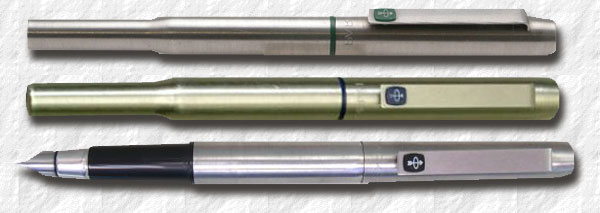
A selection of Flighter Parker "25", 1980's. Image ©
|
|
The Parker "25" range:
|
|
At a sales conference in June of 1975, when the fountain pen business was at it's lowest, Parker UK introduced the cheap, but very functional Parker "25", for the low end market. It was a Flighter, made from steel and plastic, and had easily replaceable nib/sections. The shape of the Parker "25" was a bit odd, since the back of the pen was thinner than the front end, stepped down without really being tapered. It was indeed very square in appearence and sported a new, totally square clip, with the parker logo in a — what else — square plastic emblem. The nib was also in steel but in spite of the low price it was sturdy and proved to be a surprisingly good writer. It was like the Volvo of the time — boxy but safe!
In 1979 the Matte Black Parker "25" was shown also in the US catalogue, it was referred to as the Parker "25B". Both the Flighter and Matte Black were now offered in the nib sizes Fine and Medium only. Parker discontinued the Parker "45" fountain pen (ball pen and pencil remained but the Parker "45" fountain pens didn't appear again until the mid 1980's catalogues) and bumped up the price of the Parker "25" Flighter. A Fountain pen now cost $12.50 (like the Parker "45" the year before), while a ball pen cost $7.50. The Matte Black was a tad more expensive with $15 for the fountain pen and $10 for the ball pen. In 1981 a Rollerball was introduced. |
 range came up with several designs and while they were indeed modern, most were just too modern for Parker but eventually they agreed on an all metal pen with a new one-piece collector, specially designed to handle air travel. The production technique was also relatively new. The body was made with a deep draw press which simply used a round piece of metal, like a large coin, and stamped it in several stages until it was in the shape of an elongated cup.
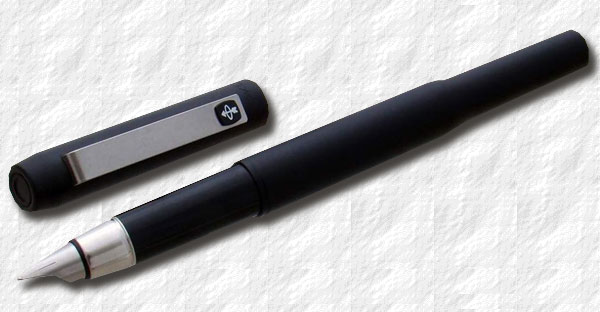
 he pen was made to be cheap and the simple design allowed for cheap production costs. It was made as a fountain pen, ball pen and later as a fibre tip and roller ball. It was an instant success in Europe. In 1978 a Matte Black Parker "25" with an epoxy resin finish was introduced in the UK. The same year the british pen also saw it's way into the US catalogue, but it was carefully stated that this pen was made in the UK, while the cartridges and converters were manufactured in the US. The Flighter Parker "25" was offered with the nib sizes of Extra Fine, Fine, Medium and Broad. It sold with a converter installed but with a washable blue cartridge of ink provided for instant use. The Fountain pen cost $10 (at this time a Parker "45" Flighter cost $12.50, a Parker "51" Flighter cost $20, a Parker "180" Flighter cost $30 and a Parker "75" Flighter cost $27.50). As in Europe, the Parker "25" became very popular, since it was an exellent writer with a futuristic design at a nice-price. It was also virtually indestructable. It was advertised as having a "Rugged, functional, space-age design". The Matte Black model really boosted the sales.
 |
|
A Matte Black Parker "25", 1980's. Image ©
|
|
The Parker "25" sold so good that Parker in the US again dared to raise the price of the Flighter in 1980. Now both the Matt Black and the Flighter cost $15 for the fountain pen and $10 for the ball pen, $25 for a set. In the long run it was clear that the Flighter model attracted the most customers so in early 1983 the Matte black was discontinued. As before mentioned times were not really good for pen manufacturers and hadn't been for decades. Parker was losing money. So when the Parker family was made an offer of $400 million from the subsidairy in Newhaven they decided that it was time to pursue other values in life. Hence Parker Newhaven in 1987 took over the Parker mother company. Again it was to be the Duofold that was to boost sales. To commemorate Parker's 100 anniversary the Centennial was introduced and in one year the new Parker company was again making money.
|
 |
|
A White Parker "25", 1980's. Special thanks to Paul Barrell
|
|
© 1995-2020 Tony Fischier and The Parker Pen Company®/Sanford Ecriture. Everything on this website is copyrighted by law and can not be used without written permission from the author, Tony Fischier. You may however use the information as reference material and although it is forbidden to make digital copies or reproductions it may be physically printed for personal use, after a small donation, this does not include use on other web pages or in advertising. You may however quote parts of the content of this website, digitally or physically, providing that the source and author is clearly stated, together with the copyright information. In the US referred to as Fair use. If you use any information from this site for online purposes, you are required to add a link to this site. Feel free to donate through Paypal to help this site to stay online. This page is in no way sponsored by or created by the Parker Pen Company®. All opinions, views, and thoughts expressed herein are expressly the authors, and in no way reflect the opinions, views, or thoughts of the Parker Pen Company®/Sanford Ecriture. All logos and/or images on these pages are © Copyright of Parker Pen Company®Sanford Ecriture unless otherwise stated, and is reprinted by kind permission. If You feel that Your copyright has been violated please contact the WEBMASTER. |